

Post Detail
BackAxon ERP Official
6 weeks ago
What Actually Needs to Be Connected in a Wholesale Distribution Business?
A wholesale distribution business does not run through one process.
A customer places an order. Stock has to be available. If it is not, purchasing may need to replenish it. The warehouse needs to know what has to be picked and dispatched. The customer account needs to reflect the sale and any outstanding amount. At the same time, management needs to know what was sold, what is still available, what has been purchased, and what is still waiting to be collected.
These are not separate activities.
They are connected parts of the same business.
Yet many wholesale distributors still manage different parts of their operation through separate spreadsheets, accounting systems, warehouse records, sales tools, or manual communication. Each department may have its own information, but the business does not always have one connected view of what is happening.
That is where problems begin.
The real question is not whether a wholesale distribution business needs more software. The more important question is:
Which parts of the business actually need to be connected for the operation to work as one system?
What Does “Connected” Actually Mean in Wholesale Distribution?
Connecting a wholesale business does not simply mean putting several modules inside the same software.
The important part is the flow of information between business processes.
When a sales order is created, the inventory position should reflect that commitment. When stock is received from a supplier, purchasing and inventory records should reflect it. When an order is fulfilled, the relevant sales and financial records should move with it.
In other words, one business event should not require several people to manually recreate the same information in different places.
A connected wholesale distribution workflow should allow information to move naturally between:
- Sales
- Customer management
- Inventory
- Purchasing
- Warehousing
- Order fulfillment
- Credit management
- Accounts receivable
- Financial reporting
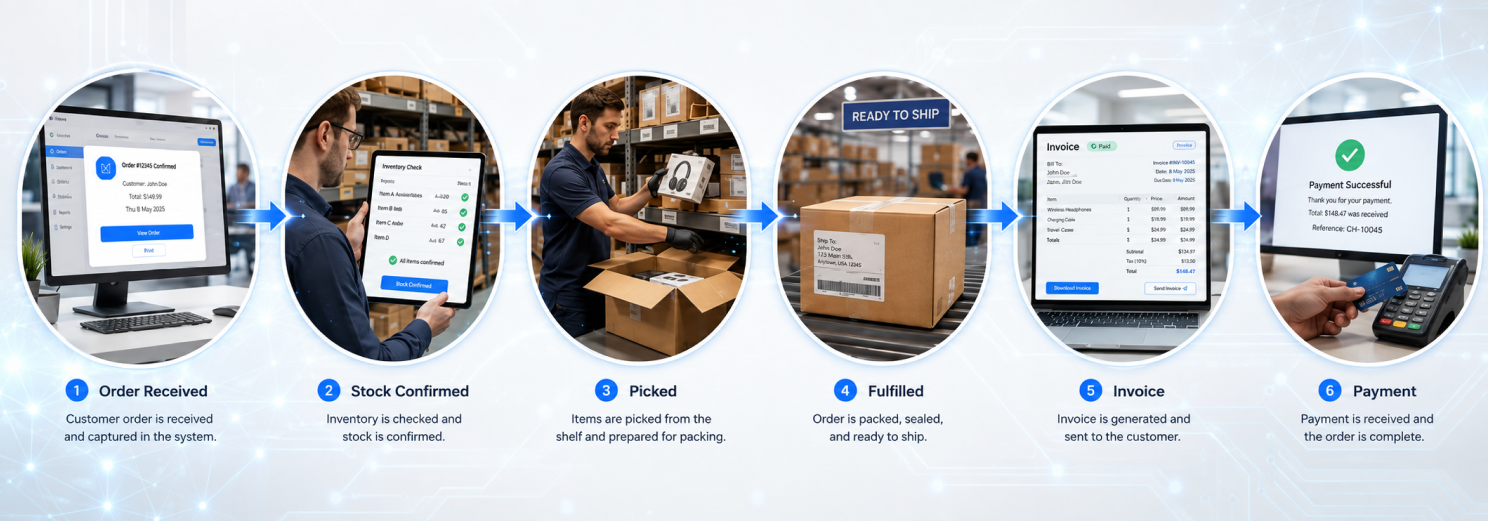
This creates a much clearer picture of what is actually happening across the business.
Sales and Inventory Need to Work Together
One of the most important connections in wholesale distribution is between sales and inventory.
A customer order is not just a sales transaction. It creates a commitment against available stock.
If the sales team can accept orders without having an accurate view of inventory, several problems can follow:
- Products may be promised when they are not actually available.
- Existing stock may be committed to multiple customers.
- Sales teams may rely on outdated stock information.
- Purchasing may not know which products are already committed.
- Customers may experience delays after placing an order.
This is why inventory and sales management should not operate independently.
When sales activity and inventory information are connected, the business can see what has been sold, what is available, what has been committed, and what may need replenishment.
That connection becomes even more important when the distributor handles multiple warehouses, branches, product categories, or large order volumes.
Purchasing and Inventory Need a Shared Picture
Purchasing decisions depend heavily on inventory information.
A purchasing team needs to know more than the quantity currently sitting in a warehouse. It needs context.
What has already been ordered from suppliers?
What stock is available?
What has already been committed to customers?
Which products are moving quickly?
Which items are approaching their required stock levels?
Without this connection, purchasing can become reactive.
The business may purchase too much because the purchasing team does not have visibility into existing stock and incoming supply. Or it may purchase too late because customer demand and inventory levels are not visible together.
This is why purchasing and inventory management need to operate as part of the same workflow.
The objective is not simply to buy more efficiently. It is to make purchasing decisions based on the actual position of the business.
Customer Orders Need to Connect With Fulfillment
In wholesale distribution, taking an order is only the beginning.
The order still needs to move through the operation.
Sales needs to know whether the order can be fulfilled. The warehouse needs to know what needs to be picked. Delivery needs the correct information. The customer needs an accurate status.
If these stages are disconnected, the same order can appear differently to different teams.
Sales may consider an order confirmed while the warehouse is still waiting for clarification.
The warehouse may have prepared stock while the sales team has not received an updated status.
A customer may be told that an order is ready when it has not actually been dispatched.
This is why wholesale order management should connect the order with the processes responsible for fulfilling it.
The goal is not merely to record an order.
The goal is to maintain a clear flow from order received → stock confirmed → order prepared → order fulfilled → customer account updated.
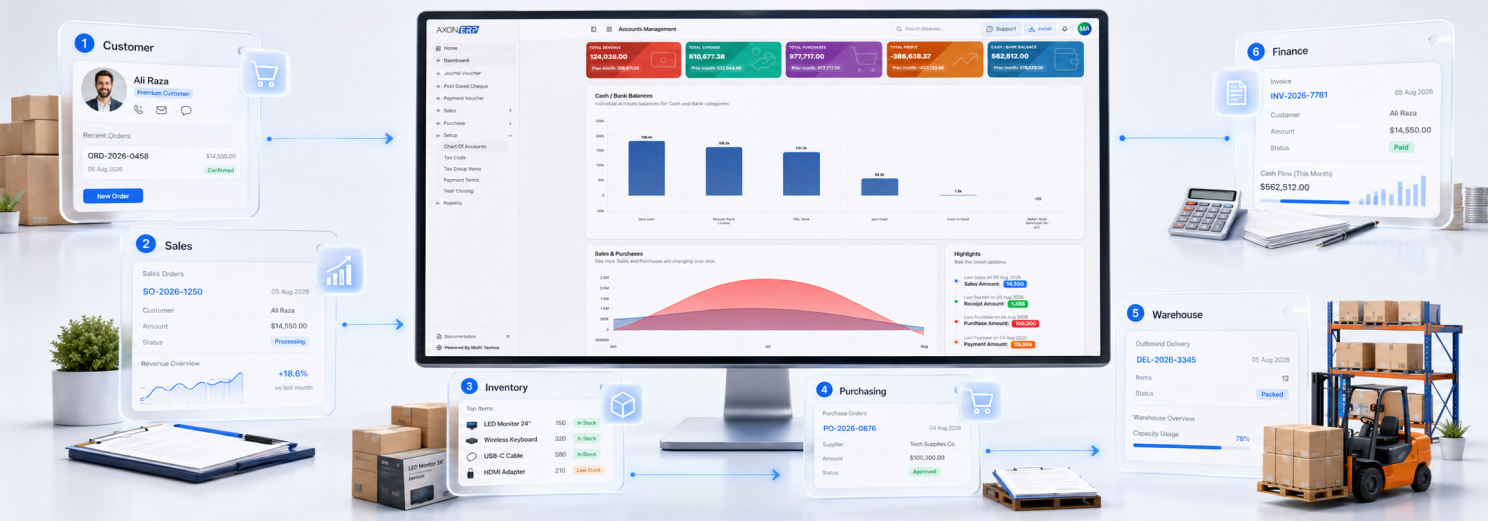
Warehouse Information Should Not Be Separate From Business Information
A warehouse is not an isolated part of a wholesale business.
Every stock movement has a business consequence.
Receiving goods affects inventory.
Transferring inventory between locations changes availability.
Dispatching an order reduces available stock.
Returning goods changes stock again.
If warehouse records are separated from sales and purchasing information, management can end up looking at several different versions of the same business.
A connected system gives the business a common view of stock movement and order activity.
This is particularly important for distributors operating across multiple locations, where knowing where stock is can be just as important as knowing how much stock exists. This idea of connecting physical movement with information flow is also reflected in GS1's supply-chain standards, which emphasize linking the movement of goods with the information associated with them.
Customer Management Should Connect With Sales
A wholesale customer is more than a name on an invoice.
Customers may have different pricing arrangements, purchasing histories, payment terms, credit limits, and outstanding balances.
That information should be available when the business is managing the customer relationship and processing sales.
This is where wholesale customer management becomes connected to sales management.
A sales team should be able to understand the customer they are dealing with rather than treating every new order as an isolated transaction.
Previous purchases, account status, outstanding amounts, and relevant customer information can all provide context for the next transaction.
The result is a more complete customer view instead of separate sales and accounting records that have to be reconciled later.
Customer Credit and Accounts Receivable Cannot Be Treated as an Afterthought
Credit sales are common in wholesale distribution.
That means the business is not finished with a transaction when the invoice is created.
The money still needs to be collected.
This creates another important connection:
Sales → Customer Credit → Invoice → Receivable → Payment
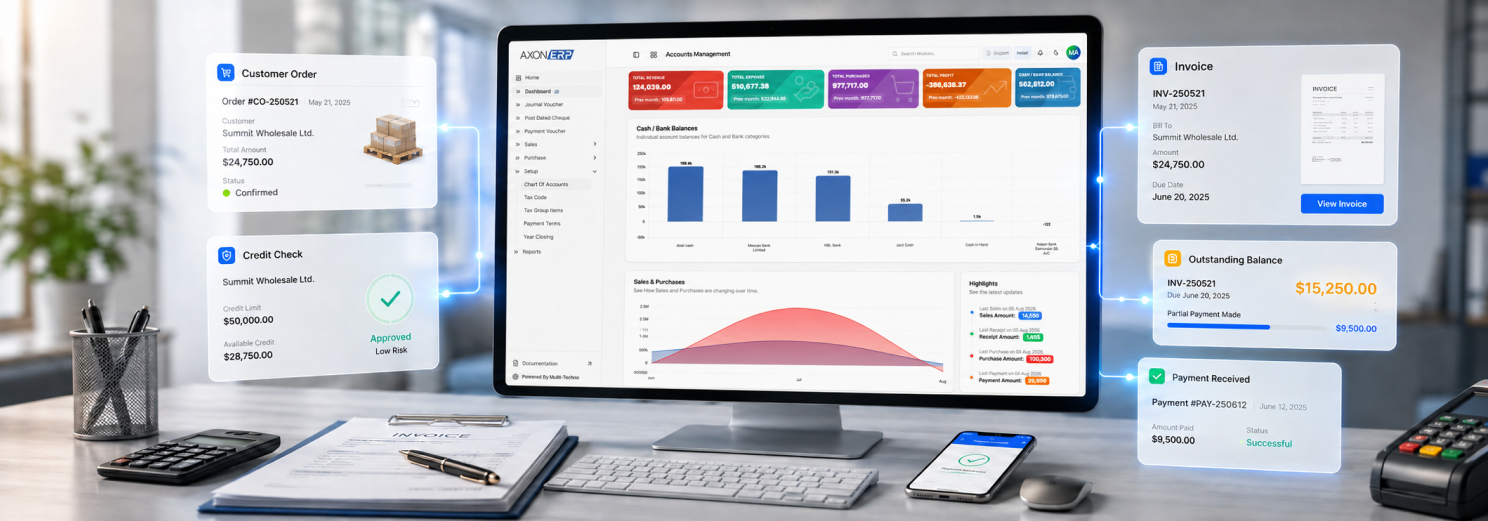
If these processes are disconnected, the business may know how much it sold without having an equally clear picture of how much it has actually collected.
Customer credit management should therefore be connected to customer accounts and sales activity.
For example, before accepting another credit transaction, the business may need to consider:
- The customer's credit limit
- Existing outstanding balance
- Customer payment tracking
- Current invoices
- Overdue amounts
- Available credit
This information becomes much more useful when it exists alongside the customer's sales history rather than in a completely separate record.
The same applies to accounts receivable for wholesale business.
Receivables should not be something the finance team discovers only after the sales process is complete. They are part of the same commercial cycle.
Supplier Management Should Connect With Purchasing
The supplier relationship also needs more than a list of vendor names.
Purchasing decisions depend on supplier information such as:
- Previous purchases
- Pricing
- Order history
- Outstanding supplier transactions
- Purchase orders
- Delivery performance
- Payment obligations
When supplier management and purchasing are disconnected, the purchasing team may have to repeatedly search for information that already exists elsewhere.
A connected approach gives the business a clearer supplier history and makes purchasing decisions easier to understand.
More importantly, supplier activity can be connected back to inventory.
A purchase is not simply a financial transaction. It can eventually become physical stock that needs to be received, stored, sold, and accounted for.
Stock and Orders Should Tell the Same Story
One of the clearest signs of a disconnected wholesale operation is when the order record and stock record tell different stories.
Imagine a product appears available in inventory.
A sales representative accepts an order based on that number.
The warehouse then discovers that part of the stock was already committed to another customer.
The problem was not necessarily that the business had no stock.
The problem was that the business did not have a complete picture of its stock commitments.
This is why stock and order synchronization matters.
The business needs to understand not just physical stock, but how that stock relates to current and upcoming orders.
That distinction can make a significant difference to purchasing, sales commitments, and customer service.
What Happens When These Processes Stay Disconnected?
Disconnected processes create more than administrative work.
They create uncertainty.
A wholesale distributor may start asking questions such as:
How much stock do we actually have?
Which orders are waiting to be fulfilled?
What do we need to purchase?
Which customers have exceeded their credit limits?
How much money is currently outstanding?
Which supplier orders are still pending?
Why does the warehouse figure not match the sales figure?
Why was an order delayed even though the product appeared to be available?
If answering these questions requires checking multiple spreadsheets, messages, systems, or people, the underlying problem is usually not a lack of data.
It is a lack of connection between the data.
A Connected Wholesale Distribution Business Looks Different
A well-connected operation does not necessarily mean that every process has to become complicated.
It means that the important business events are connected.
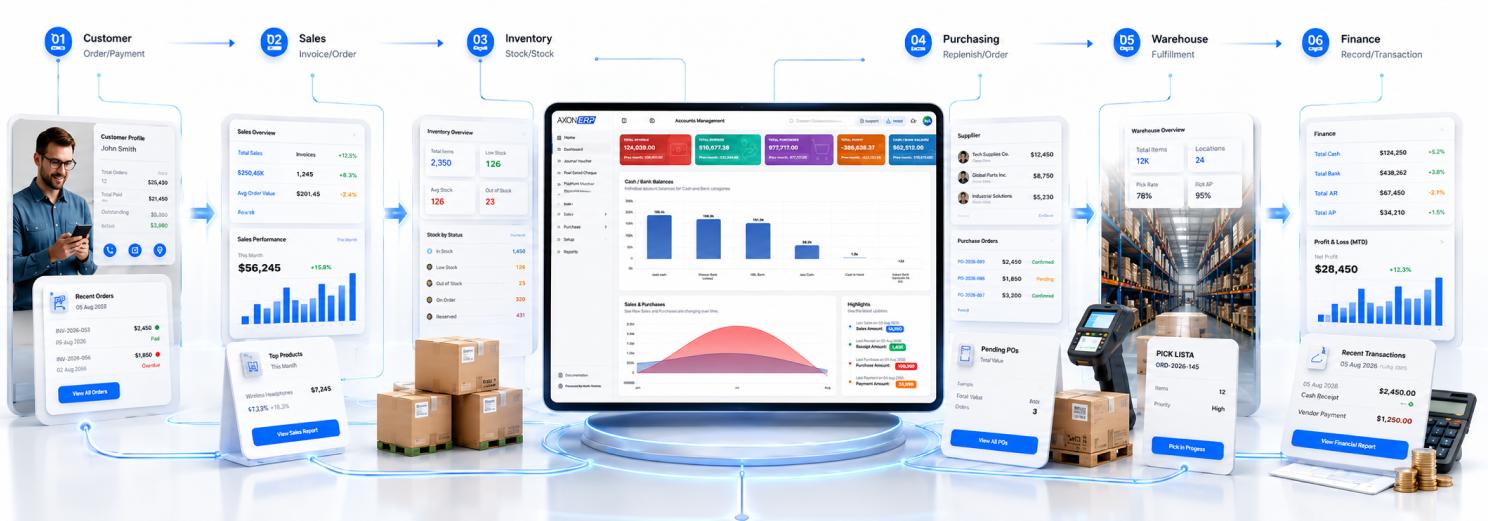
A typical flow might look like this:
Customer demand
↓
Sales order
↓
Inventory availability
↓
Warehouse fulfillment
↓
Invoice / customer account
↓
Payment / accounts receivable
At the same time, inventory connects backward to purchasing:
Inventory requirement
↓
Purchase decision
↓
Supplier order
↓
Goods received
↓
Inventory updated
These flows are not independent.
They constantly influence one another.
That is the real foundation of effective wholesale distribution management.
What Should Wholesale Distribution Software Actually Connect?
This is where the value of wholesale distribution software should be judged.
Not by the number of screens or modules it offers.
Instead, ask whether the system can connect the information that the business already depends on.
At a minimum, the important connections should include:
- Sales and inventory
- Orders and fulfillment
- Purchasing and inventory
- Warehouse and stock movement
- Customer management and sales
- Customer credit and receivables
- Supplier management and purchasing
- Sales activity and financial records
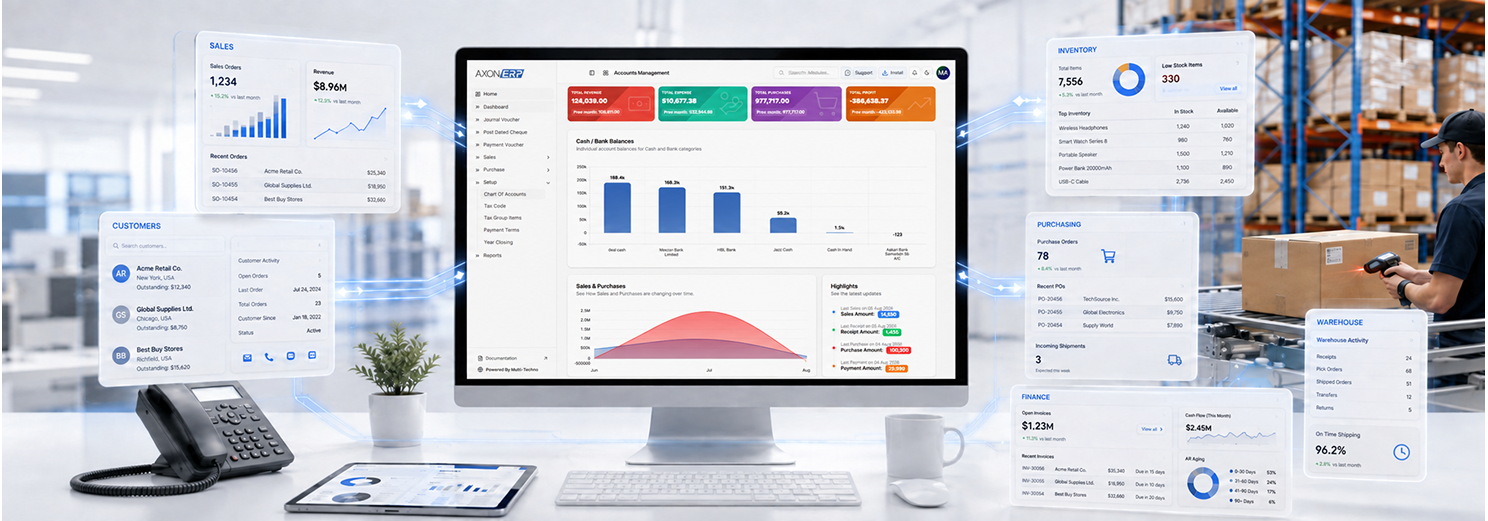
The software should help the business maintain one consistent operational picture rather than forcing every department to maintain its own version of reality.
How Axon Brings These Processes Together
Axon ERP is designed to bring core business operations into a connected system rather than treating each department as a separate operation.
For a wholesale and distribution business, this means connecting the areas that directly influence day-to-day decisions including sales, purchasing, inventory, customer accounts, and financial operations.
You can explore Axon's Wholesale & Distribution solution to see how these processes are handled within the system.
The relevant operational areas can also be explored individually through Axon's Inventory Management, Purchase Management, Sales Management, and Accounts & Finance solutions.
The important point is not simply that these functions exist.
It is that they are part of the same business workflow.
The Real Goal Is Not More Software. It Is Better Connections.
A wholesale distribution business can have excellent salespeople, reliable suppliers, experienced warehouse staff, and accurate accountants and still struggle if the information between those functions does not move properly.
The real challenge is often not individual departments.
It is the gaps between them.
Sales needs inventory accuracy.
Purchasing needs demand information.
The warehouse needs order information.
Finance needs transaction information.
Management needs all of it.
When these connections work properly, the business gains something more valuable than another software feature:
a clearer view of how the business is actually operating.
That is what a connected wholesale distribution system should ultimately provide.