


Post Detail
BackAxon ERP Official
55 min ago
Still Calling the Office to Check Inventory? A Better Way to Manage Field Sales Orders
A field sales representative is visiting a customer, discussing products, and preparing to take an order. The customer asks a simple question: “Do you have this item in stock?”
Instead of answering immediately, the representative has to call the office, message the inventory team, or wait for someone to confirm availability. If the customer requests several products, the process may need to be repeated multiple times.
This might seem like a small inconvenience, but when it happens across dozens of customer visits, it can slow down order booking, interrupt sales conversations, and make daily field operations harder to manage.
For distributors, wholesalers, and businesses with field sales teams, the underlying problem is often a lack of accessible inventory information. The team responsible for generating orders needs a reliable way to check stock and product prices without depending on repeated calls to the office.
A field sales app connected to the business's ERP system can help address this gap by bringing relevant stock, pricing, and customer information directly to the representative's mobile device.
Why Do Field Sales Reps Still Call the Office to Check Stock?
In many distribution businesses, sales representatives work outside the office while inventory and order processing are managed centrally. When these activities operate through disconnected systems, representatives may not have the information they need during a customer visit.
Several everyday issues can contribute to this problem.
1. Inventory Information Is Not Easily Accessible in the Field
A warehouse or office team may have access to inventory records, but a field representative might rely on phone calls, messaging apps, or previously shared stock lists.
These methods can create delays, particularly when stock changes throughout the day. A product that appeared available earlier may have already been allocated to another order, while newly received stock might not appear in an older list.
Without convenient access to the relevant inventory information, representatives struggle to answer customer questions confidently.
2. Stock and Sales Teams Work with Different Information
When sales and inventory records are maintained separately, teams can end up working with different versions of the same information.
A sales representative might quote a product or quantity based on an outdated update. The office team may then discover that the requested quantity is unavailable or that the product's price needs to be confirmed.
The issue is not necessarily that employees are doing their jobs incorrectly. The process itself makes it difficult to keep everyone working from consistent information.
3. Repeated Calls Interrupt Customer Conversations
Customer visits are an important part of field sales. Representatives need time to understand customer requirements, discuss products, answer questions, and identify opportunities for additional orders.
Repeatedly contacting the office interrupts that conversation. Customers may have to wait while the representative checks several products, prices, or quantities.
Over time, these interruptions can make visits less efficient and reduce the time representatives have available for other customers.
4. Manual Order Booking Creates Additional Work
Some businesses still rely on handwritten order books, phone calls, or WhatsApp messages to collect customer orders. Office staff then transfer the information into their sales or ERP system.
This process creates an additional handoff. Product names, quantities, prices, or customer details may need clarification before an order can be processed.
A connected order booking app can reduce this duplication by allowing representatives to enter customer orders directly through their mobile devices.
How Poor Stock Visibility Affects Field Sales Performance

The impact of repeated stock checks extends beyond the time spent making phone calls. It can affect the entire order management process.
Slower order booking: Representatives may spend more time confirming product availability instead of completing orders and moving to their next customer.
Uncertain customer commitments: Without reliable stock information, representatives may struggle to set realistic expectations about product availability and delivery.
More work for office staff: Employees who handle inventory and order processing can spend significant time responding to routine questions instead of completing other operational tasks.
Greater risk of order errors: Repeatedly transferring information between calls, messages, paper records, and software creates more opportunities for mistakes.
Limited visibility for managers: When field activity and order records are disconnected, managers may find it harder to understand what representatives are booking and where orders are getting delayed.
These problems are particularly relevant to FMCG distributors, wholesalers, beverage suppliers, pharmaceutical distributors, and other businesses that manage frequent customer visits and repeat orders. As order volumes grow, having a structured process for managing customer orders becomes increasingly important.
How a Field Sales App Improves Stock Visibility
A field sales app gives representatives access to relevant business information while they are visiting customers. Instead of relying entirely on the office for routine checks, they can use their mobile devices to review available information and prepare orders.
The exact capabilities depend on the software and its integration with the business's inventory system, but several functions are particularly useful.
Check Stock Before Confirming an Order
A connected inventory management system can help sales representatives access relevant stock information while discussing an order with the customer.
This helps them identify potential shortages earlier and discuss alternatives where appropriate, rather than discovering the issue after the order has been submitted.
Stock visibility must still be understood in context. Inventory can change as other orders are processed, and the accuracy of the information depends on the connected system, synchronization, and inventory procedures.
View Product Prices During Customer Visits
Representatives also need accurate pricing information when preparing orders. If they must call the office to confirm every price, the same interruption that affects stock checks can slow down the sales conversation.
A mobile order booking app can provide access to configured product prices and applicable customer price lists. Where supported, approved discount settings can also help representatives prepare orders according to business rules.
Book Customer Orders Directly on Mobile
Once product availability and pricing have been reviewed, representatives can enter the order through the app rather than writing it down for someone else to process later.
This reduces manual re-entry and gives the office a more structured way to receive orders. It also helps connect the field sales process with the business's wider sales and inventory workflow.
Access Customer Account Information
Stock is only one part of a successful customer visit. Representatives may also need to understand a customer's previous purchases, outstanding balance, credit limit, or payment history.
When this information is available through the app, the representative can have a more informed conversation and follow the business's established credit and order approval procedures.
What Happens When the Internet Connection Is Unreliable?
Connectivity is another practical challenge for field sales teams. Representatives may visit locations where mobile internet is slow, inconsistent, or temporarily unavailable.
If an app requires a continuous internet connection for every action, connectivity problems can interrupt order booking and force employees to return to paper-based processes.
An offline order booking app can help by allowing supported activities to continue without an active connection. Orders are stored locally and synchronized with the connected system when connectivity returns.
However, offline access does not automatically guarantee that every stock figure remains current. If inventory changes while a representative is offline, the information available on the device may be older than the latest central records.
Businesses should therefore understand which information is available offline, how synchronization works, and whether orders require approval or stock validation before dispatch.
The goal is to make field operations more resilient without treating offline information as a guarantee of current warehouse availability.
What Should Businesses Look for in an Order Booking App?
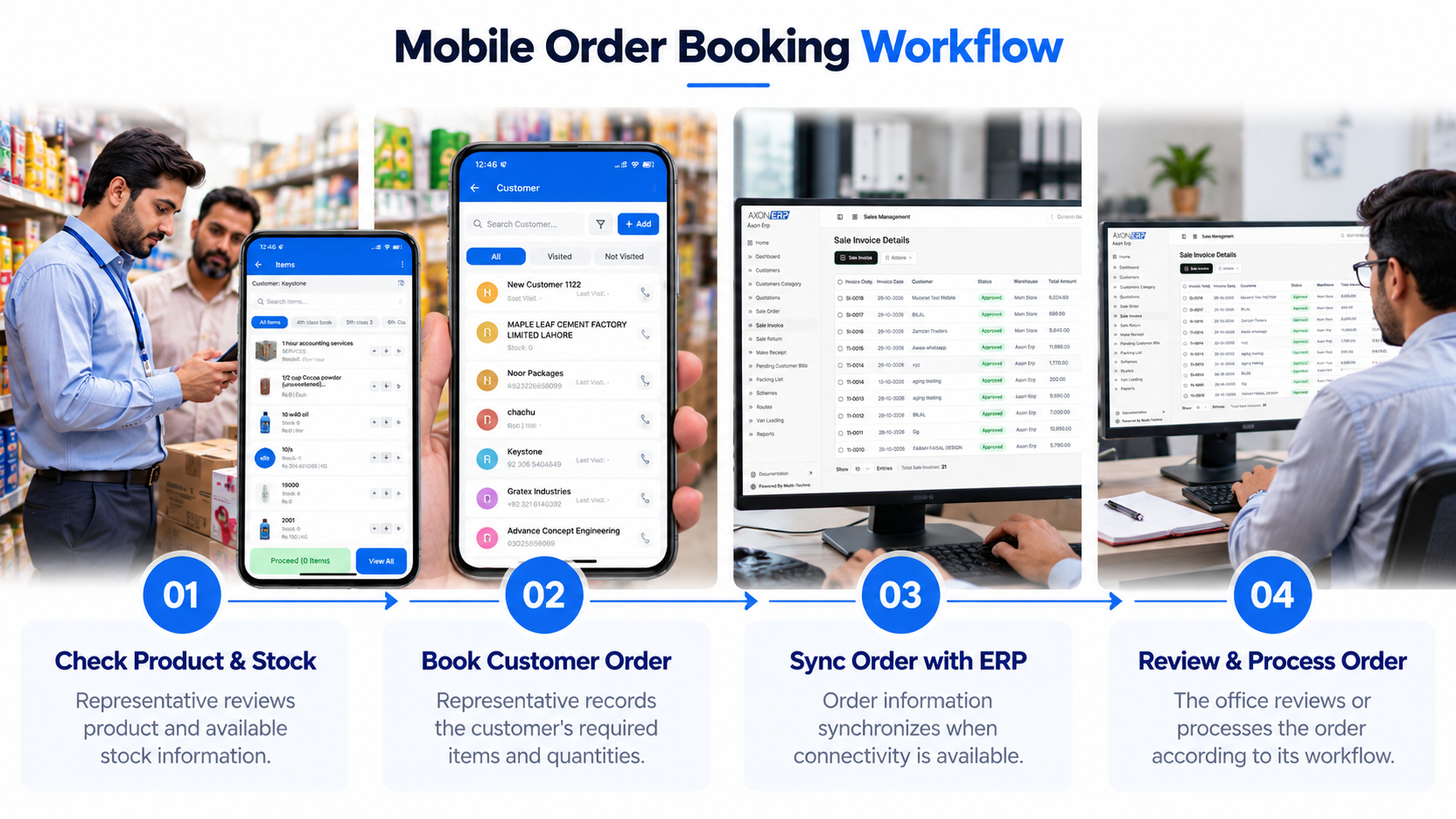
Choosing an order booking app involves more than checking whether it can create a sales order. Businesses should evaluate how well it supports the actual work of field representatives and connects with office operations.
Consider these factors before selecting a solution:
- Stock visibility: Can representatives check relevant inventory information during customer visits?
- Accurate pricing: Does the app provide the appropriate product prices and configured discounts?
- Mobile order entry: Can representatives create and submit customer orders without manually transferring information later?
- Offline functionality: What can the team do without internet access, and how does the app synchronize information afterward?
- Customer account access: Can authorized representatives review relevant customer balances, order history, and credit information?
- Order approval: Can the business configure an approval process before orders proceed to dispatch?
- A structured sales order management process can help businesses coordinate order review, approval, and subsequent processing.
- Field activity reporting: Can managers review customer visits, order activity, and sales performance through the system?
- ERP connectivity: Does the app work with the business's existing sales and inventory records rather than creating another disconnected source of information?
The most suitable solution depends on the business's sales process, product range, distribution model, and operational requirements. A small wholesale business with a few representatives may have different needs from a distributor managing multiple cities and a large field team.
How Axon ERP's Order Booking App Helps Field Sales Teams
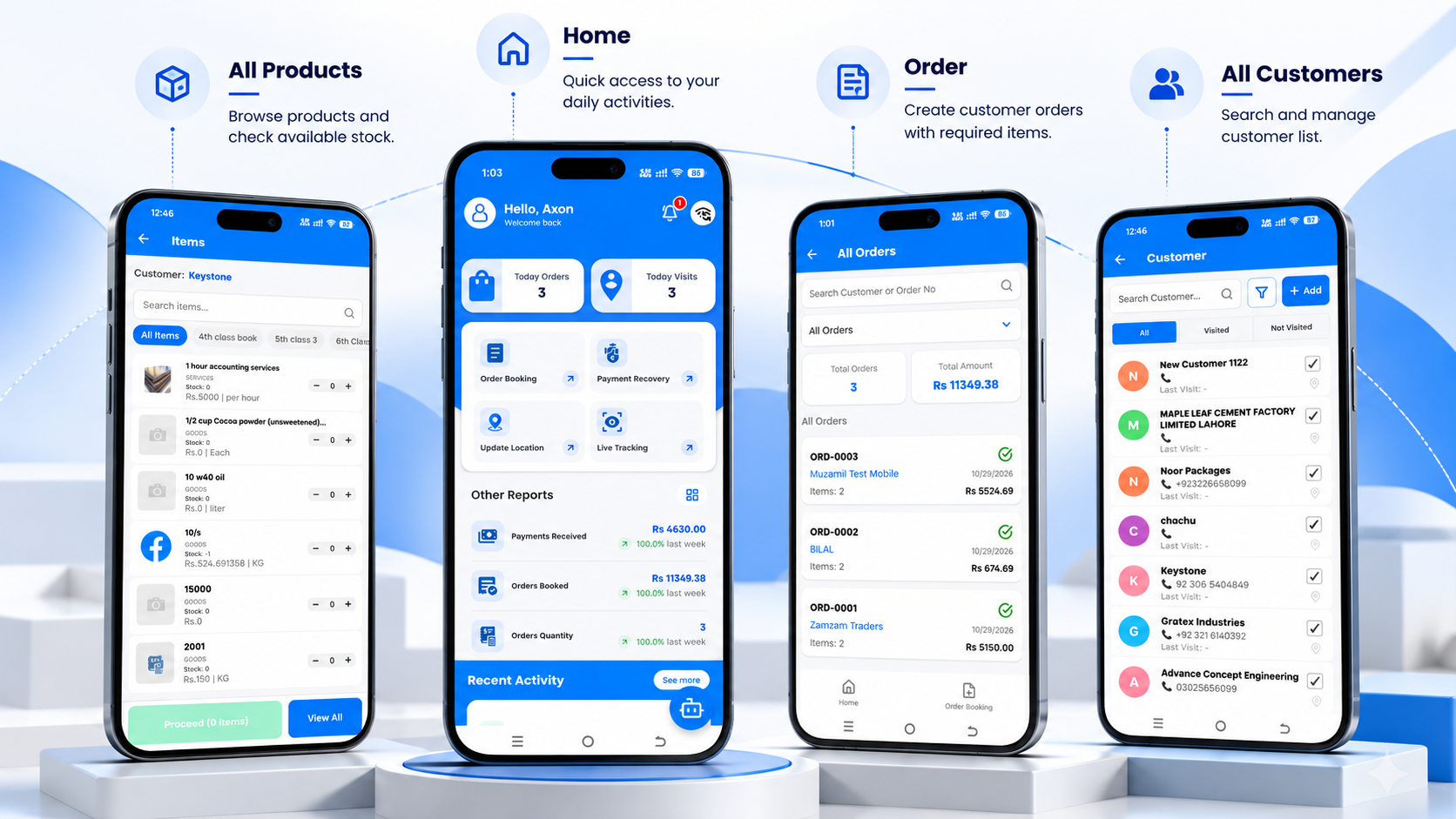
Axon ERP's Order Booking App is designed to help field sales representatives manage customer orders through their mobile devices while staying connected with the business's ERP workflow.
See the Axon ERP Order Booking App in action in this short mobile walkthrough.
Its documented capabilities include real-time stock and price visibility, mobile order taking, offline order booking with synchronization when connectivity returns, and access to customer account information such as outstanding balances, credit limits, previous orders, and payment history.
The app also supports configured price lists and discounts, GPS-tracked customer visits, daily call reports, and configurable order approval workflows.
For a distributor or wholesaler, these functions can help reduce dependence on repeated office calls, improve the process of capturing customer orders, and give management better visibility into field sales activity.
The value depends on how the business configures and uses the system. Inventory accuracy, synchronization, user permissions, and order approval rules remain important parts of the overall process.
Businesses evaluating the app should review their own workflow and confirm how its stock information, offline behavior, and order processing fit their operational requirements before implementation.
Businesses can explore the Axon Order Booking app on Google Play to review the mobile application.
Frequently Asked Questions
What is a field sales app?
A field sales app is a mobile application that helps sales representatives manage activities outside the office. Depending on the software, it may support customer information, product and price visibility, order booking, visit tracking, and sales activity reporting.
Why do field sales representatives need stock visibility?
Stock visibility helps representatives understand whether requested products appear available before preparing an order. It can reduce routine calls to the office, support better customer communication, and help identify potential stock shortages earlier.
What is the difference between an order booking app and sales order management software?
An order booking app typically focuses on capturing customer orders, often through a mobile device used by a field representative. Sales order management software may cover a broader process, including order review, approval, processing, and coordination with inventory or other business functions. The exact scope varies by product.
Can an order booking app work without an internet connection?
Some order booking apps support offline order entry by storing information on the device and synchronizing it when connectivity returns. Businesses should verify which functions remain available offline and how the app handles information that may have changed while the device was disconnected.
Does a field sales app automatically guarantee stock availability?
No. An app can display inventory information from its connected system, but actual availability depends on data accuracy, synchronization, and changes caused by other transactions. Businesses should confirm how stock updates and order validation work in their chosen solution.
Which businesses can benefit from mobile order booking?
FMCG distributors, wholesalers, beverage suppliers, pharmaceutical distributors, and businesses with representatives who regularly visit retailers or other customers may benefit from mobile order booking, particularly when they handle frequent repeat orders.
Conclusion
When field sales representatives must repeatedly call the office to check inventory, the problem often points to a gap between field operations and the information available inside the business.
Giving representatives access to relevant stock, pricing, and customer information can make order booking more efficient and reduce unnecessary communication between the field and the office. Mobile order entry and offline functionality can further support teams that work across different locations and connectivity conditions.
For businesses managing regular customer visits, the practical question is whether their current process allows representatives to check the information they need and capture orders without unnecessary delays.
A field sales app connected to the business's ERP system can help close that gap, provided its capabilities, data synchronization, and approval processes match the way the business actually operates.